Cortical atlases#
Five parcellations of the cortex, Destrieux, Desikan-Killiany, HCP-MMP1.0 (Human Connectome Project multimodal parcellation), Julich-Brain 3.1 and Schaefer 2018, are drawn on one brain’s native pial surface, on solid ribbon wedges and on cut faces. Destrieux and Desikan-Killiany are the subject’s own FreeSurfer annotations; the other three are group atlases carried from fsaverage to the subject by nearest vertex on registered spheres. Their boundaries are therefore projected estimates, not boundaries measured in this brain.
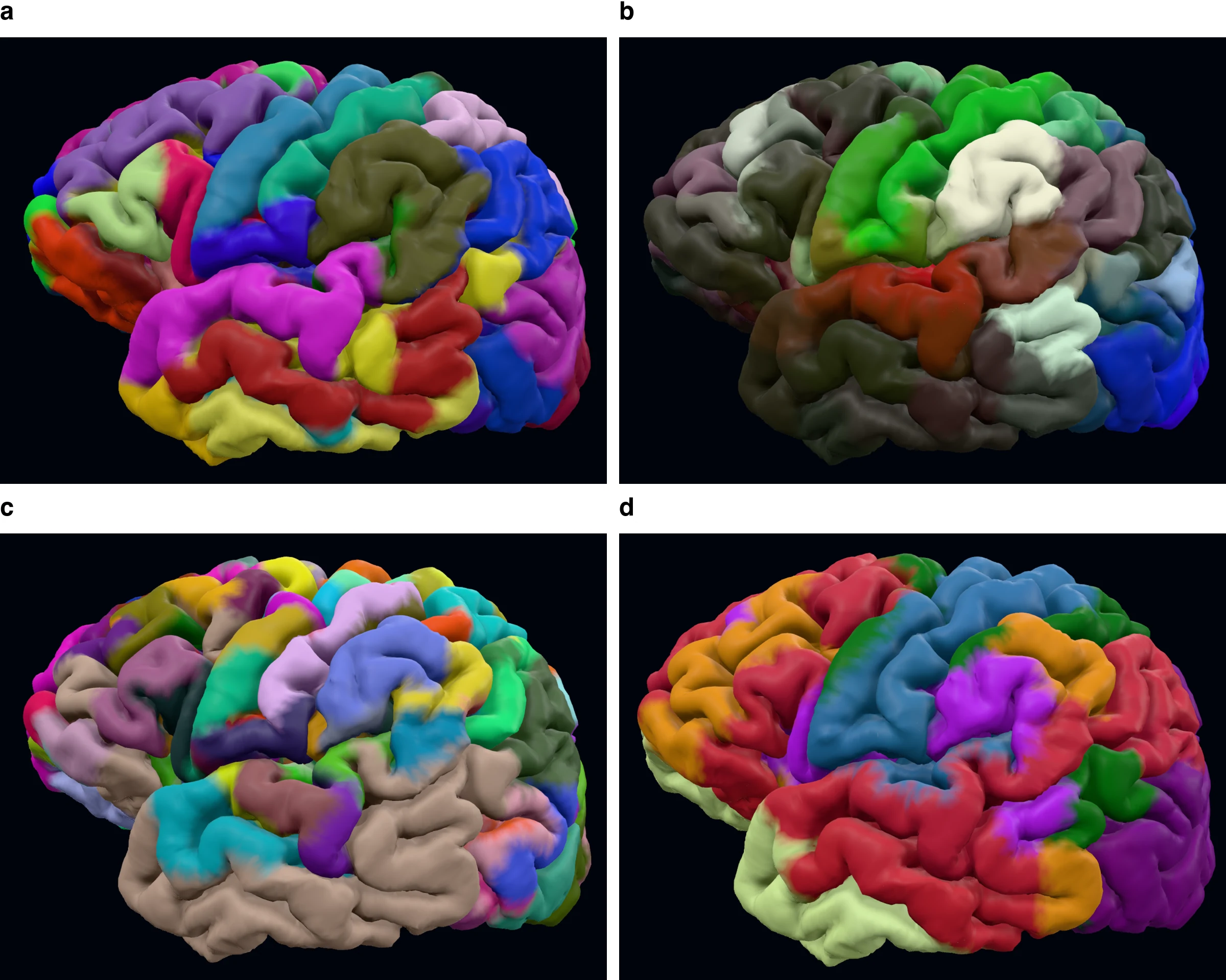
Fig. 9 | One native pial surface carries every atlas; four are shown. a, Destrieux (74 parcels per hemisphere). b, HCP-MMP1.0 (180 areas). c, Julich-Brain 3.1 (139 areas); beige is the unassigned gap-map cortex. d, Schaefer 2018 (200 parcels), in its published 7-network colours. CDMD (sub_013), left hemisphere, lateral view; identical camera and surface in every panel, internal anatomy hidden. Desikan-Killiany, the fifth atlas, is not shown.#
Data#
Atlas |
Input |
Pinned by |
|---|---|---|
Destrieux ( |
Subject |
sha256 in |
Desikan-Killiany ( |
Subject |
sha256 in |
HCP-MMP1.0 |
|
sha256 and md5 in |
Julich-Brain 3.1 |
|
sha256 constants in |
Schaefer 2018 |
|
sha256 in |
Registered spheres |
|
sha256 in |
CDMD’s pial surfaces have 108,347 (left) and 108,379 (right) vertices and 216,690 and 216,754 triangles. Published region counts (manifest.json) are 148 Destrieux parcels, 68 Desikan-Killiany regions, 360 HCP-MMP areas, 278 Julich-Brain areas and 400 Schaefer parcels, plus non-region entries: 2 medial walls each for Destrieux, Desikan-Killiany, HCP-MMP and Schaefer, and 18 for Julich-Brain (per hemisphere, 7 gap maps and 2 medial masks). Desikan-Killiany leaves its medial wall outside every table entry (label −1, 8,162 left and 8,254 right vertices); the build and the cut labels read it as entry 0. Citations: Destrieux et al. (2010), Desikan et al. (2006), Glasser et al. (2016), Amunts et al. (2020), Schaefer et al. (2018) (references).
Method#
Julich-Brain as an annotation#
scripts/fetch_julich_brain.py refuses a GIFTI file whose sha256 differs from its constant. The file must hold one integer key per fsaverage vertex. The label table is sorted by key, each key becomes its table index, and a key the table lacks stops the script. Colours are encoded as \(R + 2^8 G + 2^{16} B\); two labels with one colour stop the script. The annotation is written to data/fsaverage/label/<hemi>.JulichBrain3.1.annot and read back; no label is changed.
Projection through registered spheres#
transfer_annotation (scripts/prepare_subject.py) projects HCPMMP1, JulichBrain3.1 and Schaefer2018_400Parcels_7Networks_order for an anatomy that declares project_hcp_from (CDMD does). For each hemisphere:
resample_surface_labelsbuilds acKDTreeon thefsaveragesphere.regand gives each subjectsphere.regvertex the label of its nearest source vertex. No smoothing, no interpolation of label identifiers.The set of labels must equal the source’s: none lost, none invented.
The annotation is written with the source colours and names and read back unchanged.
512 evenly spaced target vertices (
annotation_projection.verify_samples) are re-derived by brute-force nearest neighbour.
Labels preserved per hemisphere: 181 for HCP-MMP (180 areas and the unlabelled entry), 148 for Julich-Brain (139 areas, 7 gap maps, 2 medial masks) and 201 for Schaefer (200 parcels and the medial wall). HCP-MMP’s fsaverage source is itself the published Mills projection from fs_LR, so its labels are two registrations from HCP space.
Barycentric partition of the pial surface#
build_cortex (brain_model/build.py) reads the native pial surface, which must be closed and genus zero (\(V - E + F = 2\)). partition_surface (brain_model/surfaces/geometry.py) keeps every single-label triangle and divides each mixed-label triangle into six: its three edge midpoints and centroid are added, and each corner owns the two triangles (corner, next midpoint, centroid) and (corner, centroid, previous midpoint). New points are means of their source vertices; normals are normalised means. No original vertex moves, so each region owns exactly one third of every triangle at each of its vertices and the pial area is conserved.
Each region becomes one mesh with id <atlas>:<hemisphere>:<source label>. cortical_region marks Unknown, unknown, ???, Medial_wall, CorpusCallosumMask, BrainStemMask, Background+FreeSurfer_Defined_Medial_Wall and every GapMap-* as non-region. Meshes carry _SULC (sulc), _OPENNESS (baked occlusion), _T1 (trilinear orig.mgz at pial–white midpoints) and categorical fields (_NETWORK, _TERRITORY) carried by partition_vertex_labels, which takes the repeated value of a pair, else the lowest. Exported triangles, left and right: Destrieux 287,890 and 287,044; Desikan-Killiany 256,695 and 256,734; HCP-MMP 331,760 and 332,874; Julich-Brain 318,815 and 320,309; Schaefer 326,075 and 325,579.
Schaefer names and colours#
seventeen_network_names (brain_model/layers/networks.py) pairs each 7-network parcel with its 17-network parcel on fsaverage and fails unless the pairing is one to one. The 17-network names carry a location for 175 left and 170 right parcels; no 7-network visual or somatomotor parcel has one. verify_palette requires each parcel colour within 12 per channel (networks.maximum_color_jitter) of its published Yeo colour. On CDMD every parcel survives projection; the largest share of a parcel’s vertices outside its largest connected patch is 1.6% (right hemisphere).
Ribbon wedges#
export_ribbon_labels (brain_model/surfaces/ribbons.py) writes ribbon-<atlas>.labels: one little-endian uint16 region index per pial vertex, left then right. A triangle belongs to the label held by most of its vertices; a three-way tie goes to the lowest. Each parcel closes into a wedge of its pial patch, its reversed white patch and walls along the patch boundary. The build refuses any atlas with an open wedge edge.
Cut-face labels#
export_tissue_labels (brain_model/labels/tissue_labels.py) starts from aparc.a2009s+aseg.mgz; Destrieux cut labels are those source labels. For every other atlas, Desikan-Killiany included, project_surface_atlas:
takes voxels with a Destrieux cortical label (11101–11199 left, 12101–12199 right) and sets them to annotation entry 0 (unlabelled);
gives each such voxel inside
ribbon.mgzcortex (label 3 left, 42 right) the annotation label of its nearest vertex among stacked pial and white vertices (cKDTree, index modulo the vertex count);leaves every non-cortical voxel unchanged.
The volume is cropped to its label bounding box and written as tissues-<atlas>.volume (gzip, uint16, Fortran order). Parcels are placed at their ribbon voxels (place_cortex); a parcel with no ribbon voxel keeps its surface placement, the mid-ribbon point nearest its vertex centroid.
Display#
The Atlas menu chooses the surface atlas (URL key atlas: destrieux, desikan, hcp-mmp, julich, schaefer); a cut is labelled by the same atlas unless Colour or Internal anatomy brings labels of its own (sections and cuts). cortex-<atlas>.glb loads for the chosen atlas and others on demand. The first atlas built measures the shading-field ranges and later atlases are held to them, so one decode serves every file. Region names come from web/src/lib/core/catalog/. Julich-Brain areas group by lobe from their first location tag (e.g. PostCG → Central), as Destrieux groups; Desikan-Killiany regions take the lobe Destrieux lists the same gyrus under (desikan-labels.ts) and their French names from NextBrain’s table, whose cortex has the same names. Desikan-Killiany is the atlas disorder effects are reported on; it has no atlas comparison. Schaefer parcels show their 17-network name with CBIG’s abbreviations spelled out. On a cut, tissues-<atlas>.volume is sampled on the GPU and ribbon-wedges.ts closes each parcel from ribbon-<atlas>.labels. Pairwise overlap is in atlas comparison.
Validation#
Test |
Criterion |
Result |
|---|---|---|
|
Projected annotations re-derived byte for byte |
HCP-MMP, Julich-Brain, Schaefer: identical, both hemispheres |
|
Label set preserved; 512 samples match brute-force nearest vertex |
181, 148, 201 labels per hemisphere |
|
Categorical transfer without averaging; invalid spheres fail |
passes |
|
Partition preserves area and vertex labels; exported area within relative \(10^{-6}\) |
largest parent-plane error \(6.1 \times 10^{-15}\) mm |
|
Every ribbon wedge closed (0 holes) |
pinches: 80 Destrieux, 32 Desikan-Killiany, 170 HCP-MMP, 149 Julich-Brain, 231 Schaefer |
|
Non-cortical voxels equal Destrieux; ribbon voxels equal nearest-vertex label |
passes; 181,550 left and 179,697 right ribbon voxels; 47 and 69 cortical voxels outside the ribbon |
|
7- and 17-network orders pair one to one; palette within jitter |
passes |
|
Anchor inside own label |
Desikan-Killiany 68 of 68; Julich-Brain 275 of 278; CA2 (left) and CA3 (both sides) placed on surface |
Limitations#
HCP-MMP labels are two registrations from HCP space (
fs_LR→fsaverage→ subject); the mesh is native, the labels are a group estimate.Julich-Brain leaves 24.3% (left) and 24.2% (right) of the pial area in gap maps, cortex the atlas has not mapped; the largest is
GapMap-Temporal-to-Parietal(9,870 mm² left, 11,823 mm² right).Schaefer parcels are a group resting-state estimate, not this brain’s measured function.
Projected cut labels are ribbon-restricted nearest-vertex projections of surface labels, not published volumetric atlases; they may not coincide with the surfaces at voxel scale.
Cut labels rest on one individual’s 1 mm segmentation, with no claim of subvoxel accuracy.
Licences: Julich-Brain CC BY-NC-SA 4.0 (non-commercial, share-alike); HCP-MMP1.0 under the HCP data use terms; Schaefer MIT (licences).
Code availability#
Code |
|
Configuration |
|
Tests |
|
uv run python scripts/fetch_julich_brain.py --record
uv run python scripts/prepare_subject.py --anatomy cdmd
uv run python -m brain_model.build --anatomy cdmd
uv run python -m brain_model.validate --anatomy cdmd
Figure state (panel c): https://planumatlas.com/#anatomy=cdmd&atlas=julich&view=left&hemi=left&internal=0